
ASML Holding NV — Deep Analysis Report
ASML is still the cleanest way to own EUV, but the MATCH Act and China mix make the entry price matter more than the story.

NASDAQ: ASML · Semiconductor Equipment · Report date: 13 May 2026 · All financials in €M unless stated
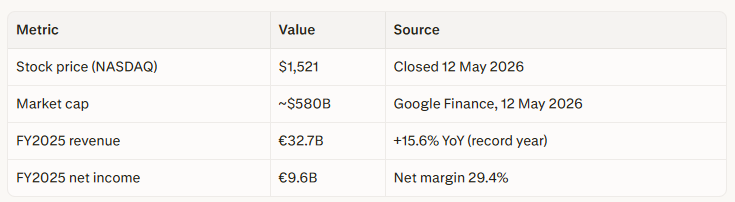
ASML Holding NV is the world's sole manufacturer of extreme ultraviolet (EUV) lithography systems — the machines that print the finest circuit patterns onto silicon wafers — and a dominant supplier of deep ultraviolet (DUV) systems. Every leading-edge chip produced by TSMC, Samsung, and Intel passes through an ASML tool. The company is best classified within the Semiconductor Equipment sub-industry, and its structural dominance is anchored in the EUV product line: a monopoly with no viable substitute on the horizon.
1. Bottleneck scorecard
Sub-industry: Semiconductor Equipment
This is a late-cycle sub-industry with a 2–4 quarter lag to fab capex. Equipment billings track foundry and memory investment plans. ASML sits at the apex of this pool as the only EUV manufacturer.
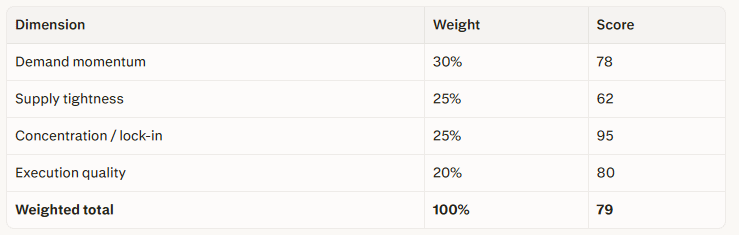
Verdict: Investable
Demand Momentum — 78/100
Hyperscaler capex (Amazon, Microsoft, Google, Meta) continues expanding at roughly 20–40% YoY through 2025–2026, sustaining AI-driven wafer demand. WSTS projects global semiconductor sales exceeding $1 trillion by 2030. ASML’s own 2026 guidance — raised in April 2026 to €36–40B in total net sales at 51–53% gross margin — signals a durable order pipeline anchored by a €38.8B backlog at end-2025. The score reflects a haircut for China headwinds and DUV growth moderation as prior pull-forward demand normalises.
Supply Tightness — 62/100
EUV supply remains genuinely constrained: ASML ships roughly ~50 low-NA EUV systems per year, with extended lead times on leading-edge tools. DUV backlogs, by contrast, are normalising as Chinese pull-forward demand fades into 2026 and mature-node capacity additions slow. High-NA EUV is being ramped carefully — only a handful of EXE systems have been delivered in early deployment, with the exact number limited. The score reflects tightness in EUV offset by looser DUV conditions and softening China demand.
Concentration / Lock-In — 95/100
ASML holds an effective global monopoly on EUV. No competitor has demonstrated a commercially viable alternative EUV platform for high-volume manufacturing. Leading-edge fabs — TSMC, Samsung, Intel — carry multi-year dependencies on ASML for both low-NA and high-NA EUV. The High-NA (EXE:5000/5200B) platform extends this monopoly into the next node transitions. This is among the highest concentrations and lock-in profiles achievable in any industrial sub-sector.
Execution Quality — 80/100
ASML has repeatedly executed complex technology ramps — ArF immersion, EUV, and now High-NA EUV — while sustaining gross margins above 50% and strong free cash flow conversion across the cycle. Occasional cycle-timing volatility and dependencies on critical suppliers (notably Carl Zeiss SMT) cap the score below 90. Even so, the operational track record is among the strongest in semiconductor equipment.
Scorecard verdict: Investable (79/100). No dimension scores below 30, so the catastrophic-weakness override does not trigger. The sub-industry bottleneck is structurally favourable. Proceed to full analysis.
2. Business Model & Bottleneck Position
ASML sells three primary product families:
EUV lithography systems (NXE and EXE series): Used for leading-edge nodes at 7nm and below. These are the crown jewels of the portfolio, commanding the highest average selling prices and gross margins.
DUV lithography systems (TWINSCAN immersion and dry): Serve mature-node and some leading-edge applications. ASML is dominant but not a pure monopoly here; Nikon competes at the margin in certain DUV segments.
Installed Base Management (IBM): Services, upgrades, and field options. IBM generated approximately €8.2B in 2025, growing roughly 26% YoY — ASML’s most predictable revenue stream, tied to the installed base rather than new system orders.
ASML is a bottleneck controller, not a bottleneck consumer. Every chipmaker pursuing leading-edge nodes must use ASML equipment, granting ASML extraordinary pricing power. Its gross margin has held consistently above 50% for three consecutive years in a capital-intensive industry, and individual systems cost upwards of €200M each. Widely cited analyst estimates place High-NA EXE system ASPs in the €300–400M range; however, this has not been formally confirmed by ASML and should be treated as an analyst estimate rather than an official datapoint.
ASML’s largest customers — TSMC, Samsung, Intel, SK Hynix, and Micron — each represent significant revenue. TSMC is widely regarded as ASML’s single largest customer and has driven a substantial share of EUV system orders during leading-edge node transitions. Industry estimates place TSMC’s contribution in the mid-20s to 30% range in certain peak EUV-ordering years, but ASML does not disclose exact single-customer percentages in its public filings. The precise figure, therefore, remains an analyst-derived estimate rather than a confirmed fact. This concentration creates meaningful order-timing and negotiation leverage at the customer level, even though no technological substitute for ASML’s EUV tools exists.
ASML’s upstream supply chain is complex — Carl Zeiss SMT supplies EUV optics as a critical single-source vendor; thousands of specialist component suppliers contribute across the system. ASML partly mitigates supplier risk through its equity stake in Zeiss SMT and deep co-development relationships. Its accumulated IP and system integration know-how create barriers that protect its position even where supplier concentration is high.
3. Financial Quality Analysis
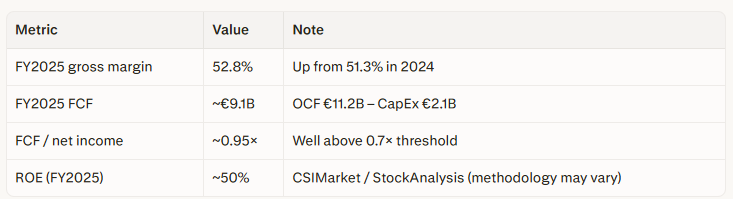
Historical Snapshot
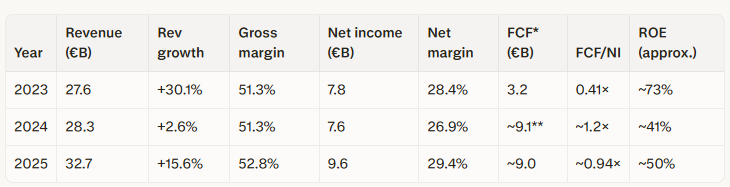
* FCF = operating cash flow − capex.
** The FY2024 FCF figure of approximately €9.1B has not been directly verified against primary-source cash flow components from ASML’s 2024 filings. It is retained as a working placeholder and should be treated as uncertain pending direct reconciliation with OCF and CapEx in the 2024 annual report.
Sources: ASML results releases and 6-K filings (Jan 2024, Jan 2025, Jan 2026), public cash flow data, and secondary aggregators. Exact ROE figures depend on methodology (average vs. end-of-period equity and buyback timing) and are presented as approximations.
Interpretation
The 2023 FCF/NI dip to 0.41× warrants context: it was driven by a capex supercycle (roughly €2.2B vs ~€0.9B in 2019) and a significant inventory build ahead of anticipated demand. By 2024–2025, FCF rebounded sharply as customer down-payments accelerated and the working capital cycle normalised. The 2025 FCF conversion of ~0.94× comfortably clears the 0.7× quality threshold, and ROE has exceeded ~40% in each of the last three years — driven by genuine margin strength and asset efficiency rather than leverage (debt/equity remains modest at ~0.13–0.24×).
Revenue growth in 2023 (+30.1%) and 2025 (+15.6%) is well above a 10% high-quality threshold. The muted +2.6% in 2024 reflects the digestion of earlier pull-forward orders (notably from China ahead of export controls) and delays in select fab buildouts (Intel, Samsung). Gross margins have been flat-to-rising, which avoids the “growth without quality” red flag. Audit opinions are unqualified. On standard quality metrics — ROE, FCF conversion, gross margins — ASML screens top-quartile within semiconductor equipment.
4. Competitive Position — Porter’s Five Forces
Threat of New Entrants — Very Low
Developing EUV technology requires decades of R&D, tens of billions in cumulative investment, and mastery of thousands of high-specification components held to extremely tight tolerances. The Carl Zeiss optics partnership alone required decades of co-development to mature. Nikon and Canon — despite their full photolithography heritage — have not produced a commercially viable EUV system for high-volume manufacturing. The transition to High-NA EUV (0.55 NA) raises these barriers further, making greenfield entry effectively prohibitive over any realistic investment horizon.
Competitive Rivalry — Effectively Zero (EUV); Moderate (DUV)
In EUV, ASML has no direct competitor. In DUV, Nikon retains a niche share in certain mature-node and non-critical-layer applications, but ASML’s immersion DUV systems dominate high-volume logic and memory production. The more relevant competitive threat is structural and geopolitical — China’s effort to build indigenous lithography alternatives — rather than any existing Western rival.
Threat of Substitutes — Low (Medium Term); Monitor Longer Term
No alternative lithography technology — multi-beam e-beam, nanoimprint, or directed self-assembly — currently matches EUV’s combination of resolution and throughput for leading-edge, high-volume manufacturing. Chiplet architectures and advanced packaging (2.5D/3D) reduce pressure to shrink nodes as aggressively, but they do not eliminate the need for leading-edge lithography in core die production. China’s SMEE is pursuing domestic litho capabilities but remains widely assessed as many years behind in EUV. Over a 10+ year horizon, both Chinese efforts and potential disruptive technologies remain non-trivial tail risks worth monitoring, but they do not represent near-term substitutes.
Bargaining Power of Suppliers — Moderate and Managed
Carl Zeiss SMT, which supplies EUV optics, is a critical single-source supplier. ASML mitigates this through a significant equity stake and deep joint development, aligning incentives and improving governance visibility. Other key inputs — speciality materials, precision mechatronics, and certain rare earths — introduce additional bottlenecks, some geographically concentrated in China. Management has discussed strategic buffer stocks and multi-sourcing programs to reduce acute disruption risk, though supplier power cannot be ignored entirely.
Bargaining Power of Buyers — Low to Moderate
TSMC, Samsung, Intel, SK Hynix, and Micron cannot substitute ASML for leading-edge EUV tools, which structurally limits their leverage in vendor negotiations. However, they constitute a highly concentrated customer base with large, discrete capex cycles. Slowdowns or delays in fab investments — as seen with Intel’s foundry timeline and Samsung projects — directly affect ASML’s order intake and shipment pacing. The boom in HBM and AI-linked memory capacity provides an offsetting demand source, but buyer concentration still manifests as cyclicality and negotiation leverage over timing, service terms, and upgrade bundles.
5. Moat Analysis
Technology & IP
ASML holds a vast patent portfolio spanning EUV light sources, multilayer mirrors and optics, wafer stage systems, and pellicle technologies. The High-NA (0.55 NA) platform is the next generational step beyond current EUV, and ASML has already begun recognising revenue on multiple EXE:5200B systems with leading customers. No competitor is currently within a full technology generation of this capability in high-volume production.
Switching Costs
Chipmakers qualify entire process flows — photoresists, masks, etch and deposition stacks, metrology, and yield optimisation — around specific ASML tool configurations. Requalifying a fab for a different lithography platform is a multi-year, multi-hundred-million-euro undertaking with significant yield risk. For leading-edge nodes, switching is effectively infeasible except over very long horizons or for greenfield fabs — and even then, no alternative EUV supplier exists.
Scale & Installed Base
ASML has thousands of systems installed globally. Each tool generates a multi-decade service and upgrade revenue stream through field options, performance enhancements, and periodic requalification. The IBM segment’s ~26% revenue growth in 2025 illustrates how the installed base is compounding into a growing annuity-like revenue layer that is less cyclical than new system shipments.
Moat width: Wide. ASML controls the single most critical bottleneck in advanced semiconductor manufacturing. Its EUV monopoly is not merely a market-share dominance — it is a structural necessity for advanced logic and leading-edge memory. The moat is deepening as High-NA EUV creates an additional dependency layer that only ASML can supply for the foreseeable future.
6. Valuation Analysis
Peer Comparison — Semiconductor Equipment
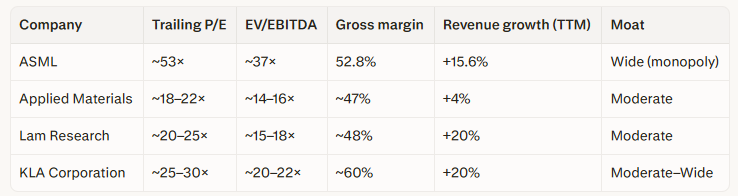
Source: public market data and company filings; peer multiples approximate as of May 2026.
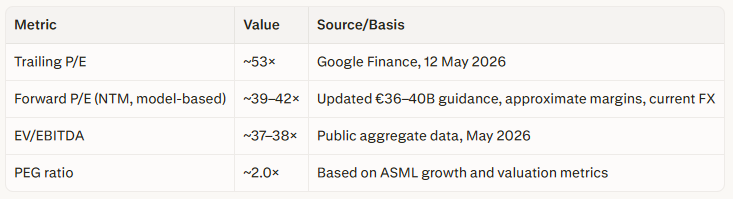
ASML trades at a meaningful premium to equipment peers — a premium structurally justified by its monopoly position, superior margins, and the irreplaceable nature of EUV technology. Over the past five years, ASML’s trailing P/E has generally ranged between roughly 35× and 55×, with compression episodes around macro and policy shocks (the 2022 rate shock, China export-control concerns). The current trailing P/E of ~53× sits toward the upper end of that historical band.
Using the updated 2026 guidance of €36–40B revenue at 51–53% gross margin and assuming net margins in line with recent years, illustrative NTM EPS estimates imply a forward P/E in the high-30s to low-40s at the current price. These forward multiples are model-dependent but indicate the stock is priced for continued strong growth and operational execution — not for disappointment.
The PEG ratio of ~2.0× places ASML at the boundary between “reasonable for a high-moat compounder” and “fully valued,” rather than at a clear discount.
Price opinion: Fairly valued to mildly overvalued. At ~$1,520, ASML trades near the high end of its historical multiple range. Business quality is exceptional, and 2026–2027 earnings growth — driven by the High-NA ramp and EUV mix shift — could make current prices look acceptable in hindsight. However, there is a limited margin of safety at this level. A patient investor is better compensated by waiting for a 15–20% pullback before building a full position.
7. Entry Timing Assessment
Four-condition entry stack
RSI recovery from below 30 (within the last 10 sessions): Not confirmed. The stock has rebounded ~6–7% over the prior two weeks from lows around $1,390, but available data do not confirm an RSI sub-30 oversold reading within the required lookback window. Condition not met.
VWAP consistency (3 consecutive closes above VWAP): Partially visible. Recent price action shows multiple closes above VWAP, but a clean three-session sequence cannot be confirmed from static data and requires live chart inspection. Monitor.
Close above 20-day SMA on the VWAP confirmation day: Likely met given the recent upswing and breakout attempts, but requires confirmation on a real-time charting platform on the precise day condition 2 is satisfied.
Volume surge ≥1.5× 20-day average on the SMA breakout day: Volume on 12 May was approximately 1.84M shares, roughly in line with the ~1.83M 20-day average. No evidence of a volume spike ≥1.5× on the latest move. Condition not yet met.
Timing verdict: Wait or starter position only. The full four-condition technical entry stack is not cleanly satisfied. Fundamentals are clearly investable and financial quality is top-quartile, making a 30% starter position defensible for long-term investors who accept near-term volatility. A full position is better reserved for a more decisive pullback toward $1,250–1,350 — roughly 10–18% below current levels — which would correspond to a forward P/E in the low-to-mid-30s on reasonable earnings estimates: historically more attractive entry territory.
8. Overall Assessment & Key Risks
ASML is one of the highest-quality businesses in the global semiconductor supply chain. Its EUV monopoly provides pricing power, margin durability, and customer lock-in that are essentially unmatched in the equipment space. The FY2025 outcome — €32.7B in revenue and €9.6B in net income, both record levels — confirms that AI-driven and advanced-node fab investments are translating into real earnings. The €38.8B end-2025 backlog offers multi-year revenue visibility, and the High-NA ramp (EXE:5000/5200B) represents a second engine of ASP-accretive growth over the next several years. The IBM service business is becoming a structurally larger and more predictable revenue component, reducing reliance on lumpy new system shipments.
Key Risk Factors
Geopolitical / export controls — the most immediate and material risk
China revenue normalisation — from ~49% of 2024 sales to ~20% in 2025, with further contraction expected in 2026
Fab capex cycle risk — delays at Intel and Samsung demonstrated the earnings impact in 2024
EUR/USD FX exposure — revenue is euro-denominated; stock trades in dollars
High-NA ramp execution — slower or costlier-than-expected customer yield adoption
Rare earth and critical component supply — geographically concentrated inputs
AI capex sentiment shifts — any moderation in hyperscaler investment plans
Long-tail risk from SMEE / alternative lithography — 10-year horizon, not near-term
The export control trajectory warrants particular attention. China accounted for an estimated ~49% of ASML’s revenue in 2024 during a pull-forward rush before tighter controls, normalising to ~20% in 2025, with further contraction implied in ASML’s geographic guidance. The proposed US MATCH Act — if enacted — would extend restrictions to DUV immersion tools and potentially their servicing, which could impair high-margin service revenues tied to the Chinese installed base. This remains a legislative risk rather than a certainty, but it is material. Non-China AI infrastructure buildouts (TSMC Arizona, Samsung Texas, EU Chips Act projects) partially offset this, but the China overhang introduces near-term earnings volatility and explains ongoing stock price swings.
Bull Case
High-NA adoption accelerates at TSMC and Samsung; Intel’s foundry recovery drives incremental EUV orders. TSMC’s overseas fabs require full EUV ecosystems, lifting tool demand. 2026 revenue hits or exceeds the top of the updated €40B range, with gross margins holding in the low-50s. Backlog converts efficiently and IBM revenues trend toward €10B+. Under this scenario, the stock could plausibly trade in the $1,800–2,000 range in 12–18 months if multiples remain elevated.
Bear Case
A stricter export-control regime (including a MATCH Act-style DUV servicing ban in China) materially reduces shipments and service revenues. A global macro slowdown or tighter financial conditions delay large fab projects and AI infrastructure capex. Intel’s foundry ambitions stall, removing one important pillar of EUV demand. High-NA yield ramp is slower or costlier than expected. AI capex enthusiasm moderates, compressing growth expectations. In this scenario, revenue undershoots consensus, the forward multiple compresses into the mid-30s to ~40×, and a price retracement into the $1,100–1,250 band is defensible under severe risk-off conditions.
Investment Opinion
Conviction: High business quality, current price fairly valued — accumulate on weakness.
ASML is a foundational long-term holding candidate for technology-oriented portfolios. Its wide moat, dominant bottleneck position, and record financial performance justify a permanent allocation in principle. However, at a trailing P/E of ~53× and a model-based forward multiple in the high-30s to low-40s, the near-term risk/reward does not offer a compelling margin of safety.
A disciplined strategy:
Position size: Limit to ~2.5% of a diversified portfolio at full allocation.
Entry:
Starter position up to ~30% of intended size at current levels for investors with long horizons and high risk tolerance.
Add meaningfully on a pullback toward $1,250–1,350.
Exit/trim signals:
Daily RSI close above 80 (over-extended momentum).
Price closes below the 10-day moving average on clearly above-average volume (potential trend breakdown).
Deterioration in fundamentals that drives the bottleneck scorecard below 50 at the next quarterly re-scoring (e.g., structural erosion of EUV dominance, severe regulatory shock).
This analysis is for educational and informational purposes only and does not constitute investment advice. All investment decisions should be made with your own due diligence and, where appropriate, consultation with a qualified financial advisor. Past performance does not guarantee future results. Data referenced are drawn from ASML financial releases, market data providers, and company press communications as of early mid May 2026.