
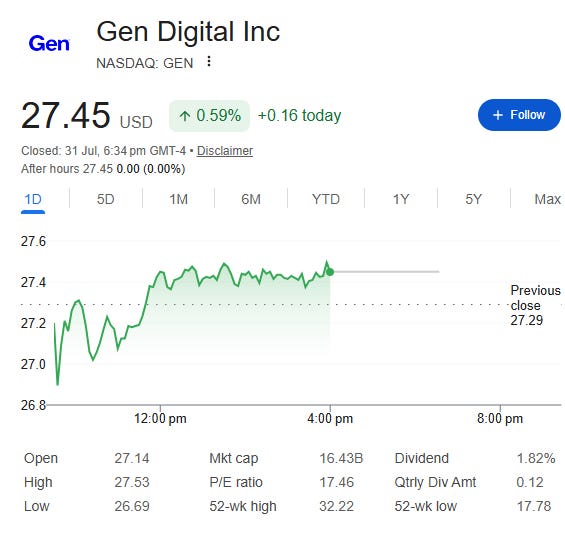
Gen Digital Inc Analysis
Cyber Safety prints 61% margins and 3% growth. Trust-Based Solutions prints 30% margins and 23% growth

As per requests from paid subscribers, it is the analysis. Please request me to do more analysis.
Introduction
Gen Digital Inc. (NASDAQ: GEN) is a publicly traded company with consumer-grade cybersecurity as its core business, owning well-known brands such as:
The core business:
Norton
Avast
AVG
Avira
CCleaner
They are a mature subscription cash machine.
In April 2025, the company completed its acquisition of the fintech platform MoneyLion, extending its business from cybersecurity to the financial health sector.
The new business:
MoneyLion
Company Overview and Business Structure
Founded in 1982 and headquartered in Tempe, Arizona, Gen Digital Inc. has nearly 500 million users in more than 150 countries worldwide. The company currently has approximately 3,900 full-time employees.
The company’s business is divided into two main segments:
One generates cash. One consumes it.
Cyber Safety Platform: Revenue of approximately $3.3 billion, with stable mid-single-digit growth, encompassing security protection, comprehensive suites, and privacy protection products, with hundreds of millions of users.
Trust-Based Solutions: Revenue approached $1.7 billion, achieving over 20% growth in key categories, encompassing identity protection, recovery support services, digital reputation, and financial health services (including the MoneyLion product).
Geographically, revenue from the US market was approximately $3.309 billion (66.18%), and revenue from EMEA was approximately $1.061 billion (21.22%).
Three Moves, One Pattern
2019. Symantec sells its enterprise security division to Broadcom for $10.7 billion. Keeps only the consumer business — Norton, LifeLock. Renames itself NortonLifeLock. Cuts the harder-to-defend, more competitive segment. Keeps the one that runs on autopay.
2021-2022. NortonLifeLock announces the acquisition of Avast for $8.1-8.6 billion, cash and stock, combining two consumer security bases into over 500 million users. Deal closes, company renames itself Gen Digital, ticker changes to GEN in November 2022. Same logic as before: buy scale, inherit a free-user funnel, don’t build one from scratch.
2024-2025. Gen announces the MoneyLion acquisition on December 10, 2024. Deal closes April 17, 2025.
Terms: $82.00 per share cash, roughly $1 billion total. Plus one contingent value right per share.
The CVR pays $23.00 in Gen stock automatically if the deal closes — that part isn’t contingent on anything; it’s guaranteed.
The actual contingency is a second layer: an additional $28.30 in Gen stock, but only if Gen’s 30-day volume-weighted average price hits at least $37.50 within 24 months of closing. Total potential consideration: up to $110.30 per share.
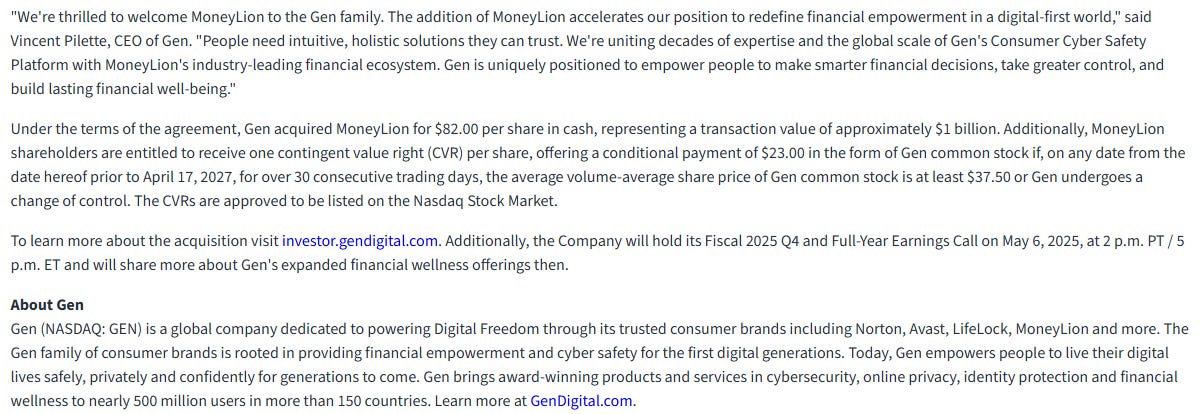
Look at what that structure actually does. Gen pays $82 cash now and guarantees $23 in stock regardless. The extra $28.30 only shows up if Gen’s own stock price rises to a level it hasn’t needed to justify with cash. Management effectively told MoneyLion’s sellers: take a fixed price today, and if our story about this acquisition driving the stock higher turns out true, you get paid more later, in our stock, funded by our own appreciation. That’s not generosity. It’s deferring cost onto a future stock price Gen is betting it can inflate partly because of this very deal.
The Cash Machine, Growing at 3%
Cyber Safety Platform — Norton, Avast, AVG, Avira, CCleaner — is roughly two-thirds of revenue, running at a 61% segment margin, pro forma growth around 3%. Per-device and per-household subscriptions, on-device agents across Windows, macOS, and mobile, backed by cloud threat intelligence handling over nine trillion telemetry rows daily.
Retention sits in the mid-70s to low-80s percent range. LifeLock’s 73 Net Promoter Score (NPS) and ~90% retention. High NPS in identity protection reflects a category where customers rarely test the competition — you don’t compare identity monitoring vendors the way you compare streaming services. Bundling into all-in-one memberships raises switching costs mechanically, regardless of how customers rate the product. The 78% company-wide retention Fitch cites sits below software peers precisely because Gen serves a churn-prone consumer base.
The Growth Cost, at Half the Margin
Trust-Based Solutions — encompassing LifeLock, ReputationDefender, MoneyLion, and GOBankingRates — reported FY2026 revenue of $1.661 billion, representing 33.22% of total company revenue. The segment operates at a 30% segment margin, a figure that has held steady throughout FY2026 and remains aligned to management’s target.
The reported growth trajectory for this segment in FY2026 was striking — full-year growth reached approximately 119%, with Q4 revenue jumping from $202 million to $446 million year-over-year, a 121% increase. However, this headline number is not organic growth. According to the FY2026 Form 10-K, the company’s net revenue increased by $1,065 million, of which $823 million was directly attributable to the acquisition of MoneyLion. An additional $87 million came from the favorable impact of an extra week in Q1 FY2026.
Stripping out the acquisition effect, the segment’s pro forma performance tells a different story: pro forma bookings grew 24% and pro forma revenue grew 23% in Q4. Within that, MoneyLion’s standalone revenue growth exceeded 40% year-over-year, with CEO Vincent Pilette noting at the Morgan Stanley Technology, Media & Telecom Conference that MoneyLion has been growing at a 40%-50% annual rate.

Inside MoneyLion: More Than Referral Fees
MoneyLion includes Instacash (paycheck advances), RoarMoney (mobile banking), and Engine (an AI-powered marketplace matching users to over 600 third-party financial products — loans, credit cards, insurance). TBS revenue: $1.661 billion, 33.2% of total. Segment margin: 30%. Pro forma growth: 23%. MoneyLion alone grew over 40% organically.
However, characterizing MoneyLion as merely “referral fees and interchange stapled onto a security company’s existing user list” understates the depth of the business. According to the Morgan Stanley conference presentation, MoneyLion’s PFM (personal financial management) and marketplace segments each grew 40% in the most recent quarter, with PFM now representing 60% of MoneyLion’s business. Engine delivered record revenue in Q4, signing over 30 new partnerships in a single quarter, with annualized queries approaching 400 million.
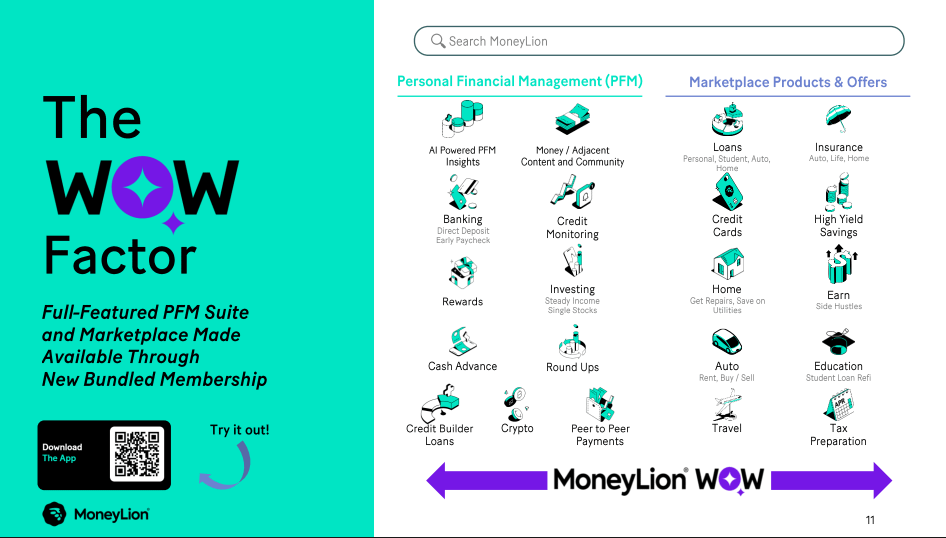
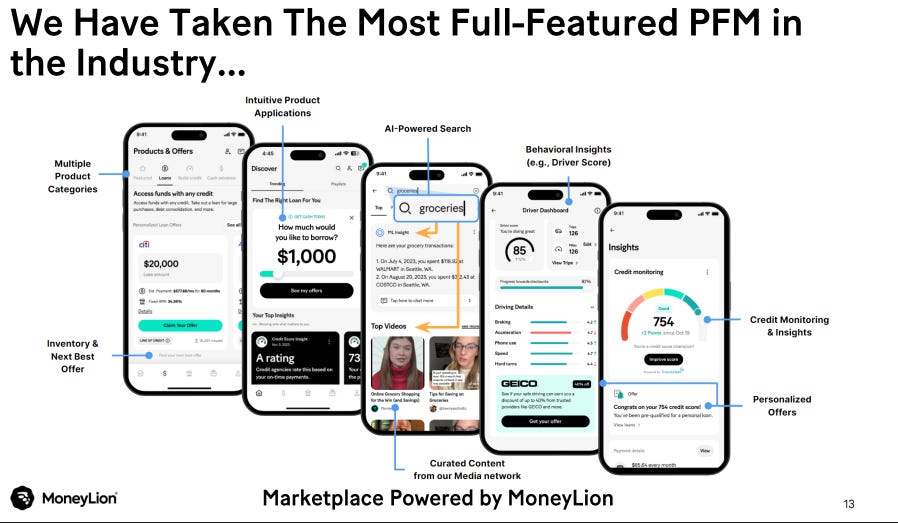
This is not a passive referral business — it is an expanding fintech ecosystem that Gen is layering onto its existing user base of over 5 billion installations. MoneyLion brought more than 18 million new customers to the combined entity, and connected financial accounts reached 107 million in Q4, up 36% year-over-year. Over two-thirds of first-party revenue now comes from repeat customers, indicating a deepening relationship rather than a one-off transaction.
The Margin Arithmetic: 61% vs. 30%
The margin differential is real and structural: Cyber Safety runs at 61%, Trust-Based Solutions at 30%. Fintech lead-generation and marketplace businesses are structurally lower-margin than software subscriptions — this is a mathematical reality.
However, MoneyLion’s own profitability is improving. At the time of acquisition, its operating margin was approximately 15%; it has since climbed to over 20%. As integration deepens and scale effects materialize, the Trust-Based Solutions segment margin has room for further expansion.
I believe margin dilution was more than offset by scale expansion.
The Part the Company Doesn’t Emphasize
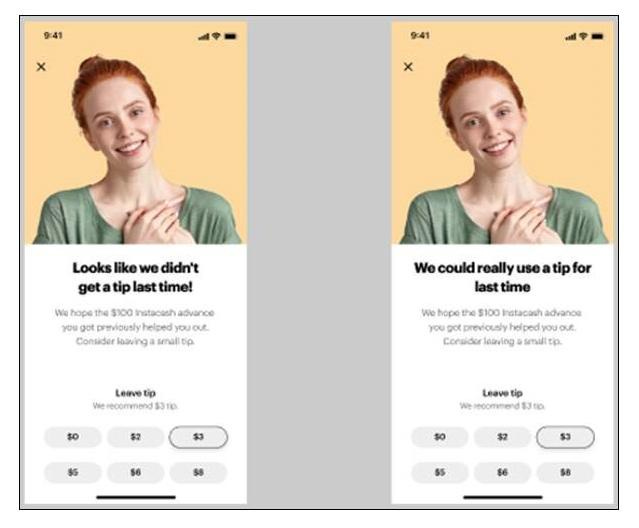
Instacash is priced like a payday loan. New York’s Attorney General sued MoneyLion in April 2025, days before the acquisition closed, alleging the “0% APR” marketing is false. The complaint’s own numbers: a $100 advance for an $8.99 fee, repaid in two weeks, works out to roughly 234% APR. Across the data period examined, MoneyLion made paycheck advances exceeding New York’s usury caps on close to 4 million occasions on fees alone, and around 1.67 million more counting tips. For its heaviest users, the effective rate on repeat advances ran near 242% APR, extracting hundreds of dollars annually. A parallel earned-wage-access suit was filed against DailyPay the same week, and the state’s action targets the wind-down of these lending practices in New York entirely.
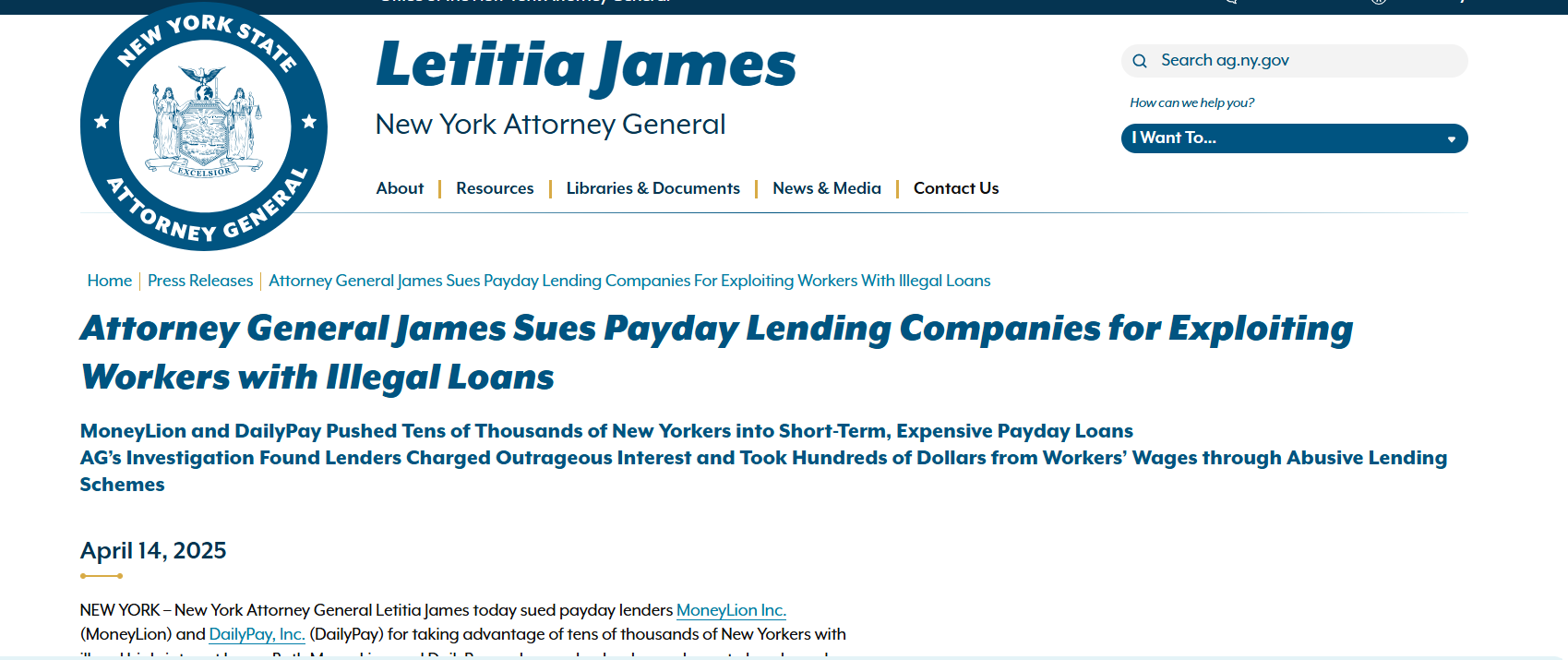
This is not a settled, priced-in legal risk. It’s live litigation over the exact product Gen is counting on to diversify its revenue base. Security software doesn’t get sued by state attorneys general over how it prices things. Payday-style lending does. Gen inherited that exposure the day the deal closed, and it sits directly inside the segment management calls its growth engine.
The Revenue Model Is Not One Thing
Gen describes itself as a subscription business. That framing is defensible, but a much better description is a hybrid-within-hybrid.
The subscription layer is the floor. Approximately 99.6% of total revenue is classified as recurring — security plans, identity protection memberships, financial wellness subscriptions. This is the cash-flow engine and the basis for the company’s capital return program.
The transaction layer changes the risk profile. Instacash generates Turbo Fees and optional Tips on paycheck advances. RoarMoney earns interchange. Engine earns referral fees from financial product matches. These revenue streams carry credit sensitivity, regulatory exposure, and operational risk that pure software subscriptions do not carry.
The cross-sell thesis is what connects them. Management’s goal is to migrate customers from point products to bundled “all-in-one Cyber Safety memberships” that layer financial monitoring onto security. In FY2026, one-third of paid customers engaged with financial wellness features. Cross-sell penetration across all products hit 26%, a record. That number is the most important operational metric in the entire company because it determines whether the bundling logic generates durable revenue or remains a feature attached to a churn-prone core.
Keep reading with a 7-day free trial
Subscribe to Capital Blueprint to keep reading this post and get 7 days of free access to the full post archives.